
OpenRoot V1 (v1) Best Version Free Download | Complete Android Rooting, Bootloader, FRP, MDM, PIN, Pattern & Lock Removal Guide
Table of Contents
Introduction
In the mobile software repair, customization, and flashing industry, technicians and advanced Android enthusiasts frequently need superuser access to repair corrupted baseband/IMEI partitions, debloat system firmware, or neutralize deep enterprise restrictions. OpenRoot V1 (v1) Latest Version stands out as a lightweight, streamlined Windows desktop utility engineered to simplify Android rooting, boot image patching, bootloader unlocking, and device security servicing.
Operating without requiring an expensive physical dongle or hardware box, OpenRoot V1 unifies ADB, Fastboot, boot/init_boot patching, and multi-brand lock-removal utilities into a clean, single-window dashboard. This comprehensive guide covers every feature, lock-removal method, system requirement, and setup step.
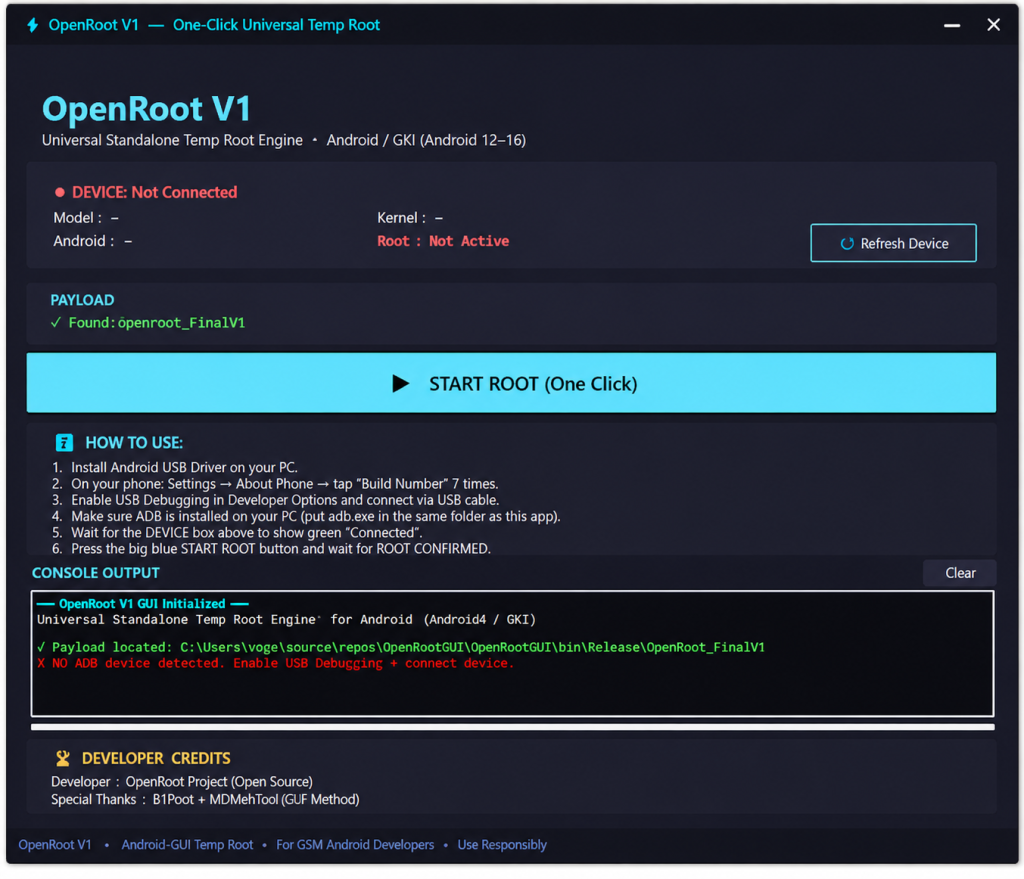
What is OpenRoot V1?
OpenRoot V1 is a Windows-based Android rooting and device servicing utility designed for GSM repair professionals and power users. By automating complex ADB and Fastboot command sequences alongside boot-image patching workflows, it enables technicians to gain root privileges, unlock bootloaders, manage system partitions, and resolve FRP, MDM, and screen-lock issues safely from one interface.
Complete Features & Servicing Modules of OpenRoot V1
The V1 release packs a focused suite of rooting, bootloader, and partition management tools into an intuitive layout:
1. Automated Rooting & Boot Image Patcher
- 1-Click Root & Superuser Deployment: Automates root binary installation and superuser verification across supported Android builds without manual command-line typing.
- Magisk / KernelSU
boot.img&init_boot.imgPatcher: Extracts or loads stockboot.img/init_boot.imgfiles, patches them cleanly for modern Android versions (including Android 13, 14, 15, and 16 partition layouts), and flashes the patched image via Fastboot. - Root Checker & Safety / Integrity Diagnostics: Verifies active
subinary status, SELinux state,dm-veritystatus, and active A/B slot configuration.
2. Bootloader & Partition Management Utilities
- Fastboot Bootloader Unlock & Relock: Supports standard OEM unlock (
fastboot flashing unlock/oem unlock) and brand-specific unlock token workflows on supported Xiaomi, Motorola, OnePlus, and Google Pixel devices. - Slot A / Slot B Switching &
vbmetaPatching: Switch active boot slots seamlessly and flash disabledvbmetaverification images to prevent boot loops after modifying system or boot partitions. - Custom Recovery (TWRP / OrangeFox) Flasher: Flash custom recovery images in one click and boot directly into recovery mode without stock recovery overwriting it.
3. ADB & Fastboot System Servicing Suite
- System Debloater & APK Manager: Uninstall or disable stubborn system apps, carrier bloatware, and background update agents via ADB without bricking core OS services.
- Diagnostic (Diag) Port & EFS / NVRAM Helper: Enables Qualcomm Diagnostic (Diag) mode with root privileges so technicians can back up, restore, and repair corrupted
EFS,QCN, orNVRAMcalibration partitions. - 1-Click Reboot Controller: Instantly reboot connected devices into Normal Mode, Recovery Mode, Fastboot / Bootloader Mode, Samsung Download Mode, or Qualcomm EDL 9008 Mode.
Comprehensive Lock Removal Capabilities (FRP, MDM, Knox, PIN & Pattern Locks)
Modern Android smartphones incorporate multi-layered security encryption to safeguard user and enterprise data. OpenRoot V1 provides dedicated utilities—both pre-root and root-assisted—to address every major type of device lock:
1. FRP Bypass (Factory Reset Protection)
When an Android smartphone is factory reset without signing out of the primary Google account, FRP blocks setup access. OpenRoot V1 includes Fastboot FRP Erase, ADB FRP Reset, and partition-level frp / persistent clearing tools to remove Google verification barriers across supported devices.
2. MDM, Knox Guard (KG) & IT Admin Removal
Corporate-managed phones, school tablets, and financed handsets often enforce strict Mobile Device Management (MDM), Samsung Knox Guard (KG), or Device Owner restrictions. Using root-level system package disabling, Device Owner policy removal via ADB, and OTA update blockers, technicians can neutralize enterprise restrictions cleanly.
3. PIN, Password, and Pattern Lock Reset
Forgetting a screen security credential—whether a numeric PIN, alphanumeric password, or gesture pattern—renders a phone inaccessible. OpenRoot V1 offers Fastboot Format Data (userdata wipe) and root/recovery-assisted gatekeeper / locksettings.db clearing routines to remove forgotten screen locks safely.
4. Carrier & OEM Bootloader Locks
Beyond standard Android locks, the utility assists with OEM Unlocking preparation and root-level carrier configuration adjustments on supported models.
Supported Brands and Chipsets
OpenRoot V1 delivers broad compatibility across major Android brands and hardware platforms:
- Supported Chipsets: Qualcomm Snapdragon, MediaTek (MTK Helio & Dimensity), Samsung Exynos, Unisoc / Spreadtrum (SPD), and Google Tensor (via standard ADB/Fastboot protocols).
- Supported Brands: Samsung Galaxy, Xiaomi, Redmi, POCO, OnePlus, Motorola, Google Pixel, OPPO, Realme, Vivo, Huawei/Honor (legacy unlocked models), Nokia/HMD, and generic Android devices.
System Requirements
| Component | Component | Recommended Specification |
| Operating System | Windows 7 / 8 / 10 (32-bit & 64-bit) | Windows 10 / 11 (64-bit) |
| Processor | Intel Core 2 Duo / AMD Dual-Core (2.0 GHz) | Intel Core i3 / AMD Ryzen 3 or higher |
| RAM | 2 GB RAM | 4 GB RAM or higher |
| Storage Space | 200 MB free disk space | 5 GB available space (for stock boot.img & backups) |
| USB Drivers | Universal ADB & Fastboot Drivers | Google Platform-Tools + Brand USB Drivers |
How to Download, Install, and Use OpenRoot V1
- Download the Setup Archive: Download the official OpenRoot V1 compressed
.zipor.rarpackage from a trusted repository. - Temporarily Pause Antivirus: Windows Defender and third-party antivirus suites often flag rooting and ADB/Fastboot utilities due to packed root binaries and exploit scripts. Temporarily disable real-time protection or add an exclusion folder before extracting.
- Extract All Files: Unpack the archive into a dedicated folder on your
C:drive (e.g.,C:\OpenRoot_V1) using WinRAR or 7-Zip soadb.exeandfastboot.exestay in the same directory as the main executable. - Install Required USB Drivers: Ensure official Google ADB / Fastboot Drivers and manufacturer USB drivers (Samsung, Xiaomi, Motorola, Qualcomm, or MediaTek) are properly installed in Windows Device Manager.
- Prepare Your Android Device: Enable Developer Options on your phone, turn on USB Debugging and OEM Unlocking (if unlocking the bootloader or rooting), and connect the phone via a reliable USB data cable.
- Launch OpenRoot V1 & Execute Task: Right-click
OpenRoot.exe, select Run as administrator, verify device detection in the status bar, choose your desired operation (Root Device, Patch Boot Image, Unlock Bootloader, Erase FRP, Remove MDM, or Format Data), and click Start.
Frequently Asked Questions (FAQ)
Q1: Is OpenRoot V1 free to use, and does it require a dongle?
Ans: Yes, OpenRoot V1 is a free, dongle-free Windows utility that works directly over standard USB connections using ADB and Fastboot protocols without requiring any physical hardware box.
Q2: Does rooting or unlocking the bootloader with OpenRoot V1 erase data?
Ans: Unlocking the bootloader (fastboot flashing unlock) on modern Android devices automatically triggers a full factory data reset for security reasons. If your bootloader is already unlocked, flashing a patched boot.img or init_boot.img to gain root access generally preserves your existing user data. Always back up important files beforehand.
Q3: Will removing a PIN, pattern, or FRP lock delete personal data?
Ans: Performing a Fastboot Format Data or userdata wipe to clear a forgotten PIN or pattern lock will erase all personal files on the device. Removing FRP on an already-reset phone clears the Google verification partition so you can complete setup. Always back up EFS and NVRAM partitions before making low-level modifications.
Q4: Why is OpenRoot V1 failing to detect my phone in Fastboot mode?
Ans: Fastboot detection issues usually occur when Windows installs a generic driver instead of the Android Bootloader Interface driver. Open Windows Device Manager while the phone is in Fastboot mode, update the driver manually to Android Bootloader Interface, and connect the phone directly to a rear motherboard USB port.
Conclusion
The OpenRoot V1 (v1) Latest Version is a practical, lightweight utility for mobile repair technicians and Android enthusiasts needing streamlined root access, bootloader control, and lock-removal tools. By combining 1-click root workflows, Magisk/KernelSU boot image patching, Diagnostic port enabling, and targeted FRP, MDM, PIN, and pattern lock removal into a single Windows interface, it simplifies everyday Android servicing. Always ensure official ADB/Fastboot drivers are installed and back up critical partitions (boot, EFS, and NVRAM) before executing system modifications.